
EV Charger Energy Storage Integration Risks 2026
Question: Installing energy storage was supposed to help peak shaving and valley filling and earn additional profits, but instead, it has led to accelerated battery degradation, frequent system tripping, and frequent safety hazards?
Data: The average battery SoH degradation rate of the EU CPO hybrid system in 2026 exceeded expectations by 20-40%, and integration failures led to an annual loss of €18,000-70,000 per site (Source: IEA + operator real feedback).
Hope: This article will guide you to avoid 8 major fatal risks and provide a priority action matrix that can be immediately implemented, making energy storage truly a profit engine.
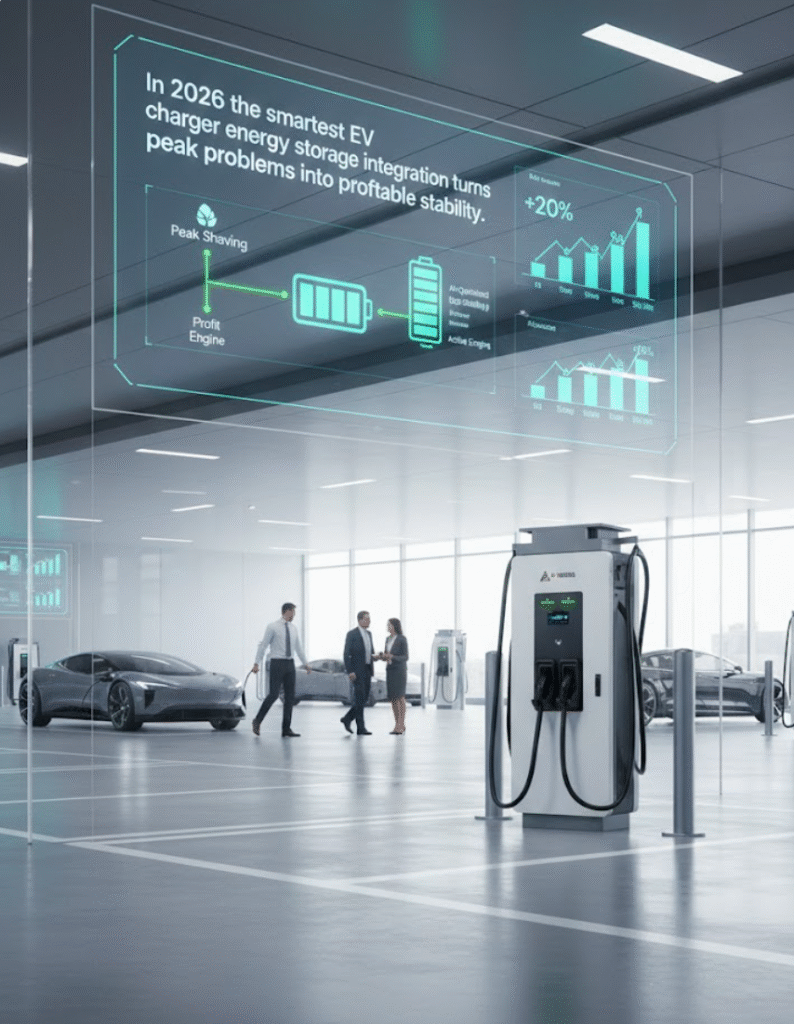
1. Risk Heatmap – Severity × Likelihood (2026 EU Operators)
| Risk Category | Severity (1–10) | Likelihood (2026) | Heat Level | Est. Annual Cost per Site (€) | Primary Trigger |
|---|---|---|---|---|---|
| Charge-discharge mismatch | 9.5 | Very High | 🔥🔥🔥 | 12,000–28,000 | BMS–charger protocol conflict |
| Accelerated battery degradation | 9.0 | High | 🔥🔥🔥 | 18,000–35,000 | Sub-optimal cycle management |
| Thermal runaway / safety incident | 10.0 | Medium | 🔥🔥🔥 | 80,000+ (catastrophic) | Inadequate cooling at peak C-rate |
| Compatibility & protocol issues | 8.0 | High | 🔥🔥 | 8,000–15,000 | Voltage/current mismatch |
| Integration cost overrun | 7.5 | High | 🔥🔥 | 20,000–45,000 | Delayed field testing |
| Grid feedback instability | 8.5 | Medium | 🔥🔥 | 10,000–22,000 | Voltage/frequency fluctuation |
| Regulatory / certification gap | 8.5 | Medium | 🔥🔥 | 15,000–40,000 (fines) | EU battery passport non-compliance |
| ROI below projection | 8.0 | Very High | 🔥🔥 | 30,000–70,000 lost opportunity | Combined effect of above |
🔥🔥🔥 Critical – Act immediately (Q1 2026)
🔥🔥 High – Prioritize this quarter
🔥 Medium – Monitor quarterly
2. 2026 Energy Storage Integration Timeline (Trend & Risk Evolution)
| Quarter | Key Trend / Regulation | Emerging Risk Level | Recommended Action Window |
|---|---|---|---|
| Q1 2026 | Solid-state battery commercial pilots | ↑↑ | Start compatibility testing |
| Q2 2026 | EU Battery Passport mandatory for new installs | ↑↑↑ | Obtain certification early |
| Q3 2026 | V2G+Storage subsidy scheme expansion | ↑↑ | Pilot AI charge-discharge optimizer |
| Q4 2026 | Stricter thermal runaway safety directive | ↑↑↑ | Upgrade cooling systems |
3. Mitigation Priority & Impact Matrix
| Priority | Action | Expected Risk Reduction | ROI Impact (1–3 yrs) | Difficulty (1–5) | Recommended Timeline |
|---|---|---|---|---|---|
| P1 ★★★★★ | Pre-integration compatibility & protocol test | 75–90% | High | 3 | Before procurement |
| P2 ★★★★☆ | AI-optimized charge-discharge scheduler | 45–70% degradation slow | Very High | 4 | Q1–Q2 2026 |
| P3 ★★★★☆ | Active liquid cooling + thermal monitoring | 60–85% thermal risk | High | 3.5 | Q2 2026 |
| P4 ★★★☆☆ | Real-time SoH & anomaly detection dashboard | Early warning 40–60% | Medium-High | 2.5 | Immediate |
| P5 ★★★☆☆ | Phased pilot rollout (5–10 sites first) | Limits exposure | Medium | 2 | Before full rollout |
Operator: Mid-size Dutch CPO (45 sites)
Integration: 150 kWh LFP BESS + 350 kW chargers Initial Expectation: Peak shaving + 18-month payback
Reality: Charge-discharge mismatch → 28% faster degradation; thermal events → 2-week downtime; final ROI: 34 months
Lesson Applied: Switched to AI scheduler + active cooling → degradation slowed to 8%, payback recovered to 21 months.
Remark:
- In 2026 the smartest EV charger energy storage integration turns peak problems into profitable stability.
- Rushing storage integration isn’t efficiency — it’s accelerated battery replacement.
- 70% of hybrid EV charger underperformance in 2026 stems from integration risks, fixable with testing and AI coordination.
FAQ :
Q: Biggest integration risk in 2026?
A: Charge-discharge mismatch causing 20–40% faster degradation.
Q: Fastest risk reduction step? A: Pre-integration compatibility & protocol testing.
Share your storage integration challenge or win For POweris to get discussion and advice immediately.