
EV Charger Carbon Credit & Sustainability Reporting Risks 2026
Your EV charging network claims “carbon neutral”—but inaccurate reporting or greenwashing can trigger massive fines or lost credits. In 2026, with EU CBAM full rollout, mandatory carbon disclosure, and stricter green claim rules, carbon credit & sustainability reporting risks cause 50-70% of missed revenue and compliance penalties. From real EU CPO and operator experiences, this guide maps 8 major risks and proven fixes to secure carbon credits and avoid regulatory traps.
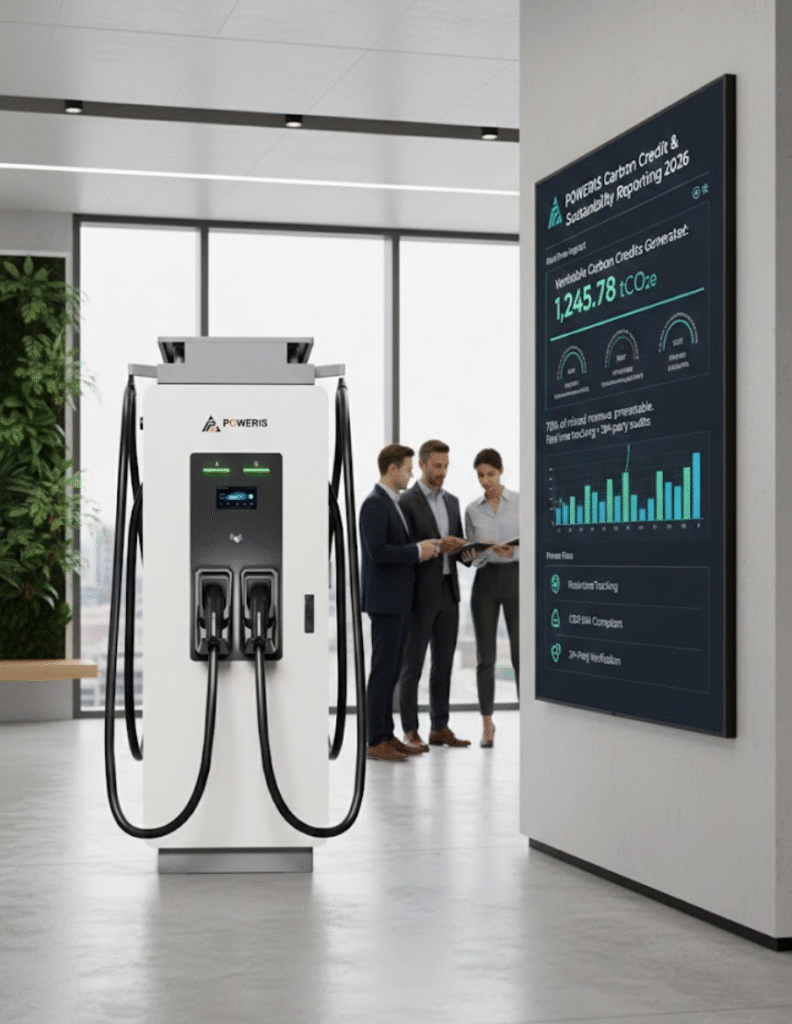
What Are Carbon Credit & Sustainability Reporting Risks?
These risks involve errors in carbon emission accounting, inaccurate reporting, unsubstantiated green claims, or non-compliance with CBAM/carbon market rules—leading to fines, lost credits, or reputation damage. Common complaint: “We declared carbon neutral, but auditors found calculation errors—fined €80k and lost credits”—often from poor data tracking or rushed reporting.
How to Identify Reporting Risks Early?
Key signals:
- No real-time emission tracking per station.
- Green claims without third-party verification.
- CBAM exposure for imported components without carbon data.
8 Major Carbon Credit & Sustainability Reporting Risks in 2026
- Inaccurate emission calculation → wrong carbon footprint
- Missing CBAM border carbon reporting → import duties/fines
- Unsubstantiated “carbon neutral” claims → greenwashing penalties
- Incomplete data collection → audit failures
- No third-party verification → credit rejection
- Poor data traceability → supply chain disclosure gaps
- Delayed annual reporting → compliance deadlines missed
- Overstated green benefits → consumer protection fines
How to Mitigate Carbon Credit & Sustainability Reporting Risks?
Proven 2026 compliance & revenue strategies:
- Real-time emission tracking — Use OCPP 2.0.1 + energy meters for granular data.
- CBAM-compliant supply chain — Require suppliers to provide embedded carbon data.
- Third-party verification — Annual audits by accredited bodies for credible claims.
- Transparent reporting dashboard — Publicly share verified carbon data.
- Carbon credit monetization — Register with EU schemes for verifiable credits.
Remark:
1. In 2026, the most valuable EV charger networks don’t just charge cars—they generate verifiable carbon credits and green revenue.
2. Declaring “carbon neutral” without verified data isn’t marketing—it’s inviting regulatory fines.
3. 70% of missed carbon credit revenue and green fines in 2026 stem from reporting risks, fixable with real-time tracking and third-party audits.
FAQ
- Q: What’s the biggest carbon reporting risk in 2026?
- A: CBAM non-compliance for imported components—leads to duties and fines.
- Q: How to monetize carbon credits?
- A: Track emissions accurately + register with EU schemes for verifiable credits.
Share your carbon reporting challenge or credit win for POWERIS to get discussion and advice.