
EV Charger Energy Storage Integration Risks 2026
Adding battery storage to EV chargers should deliver peak shaving, backup power, and extra revenue—yet poor integration frequently leads to faster degradation, safety incidents, and ROI collapse. In 2026, with solid-state batteries entering mass deployment and V2G+storage synergies becoming mainstream, energy storage integration risks are now one of the top reasons hybrid systems underperform or fail entirely.
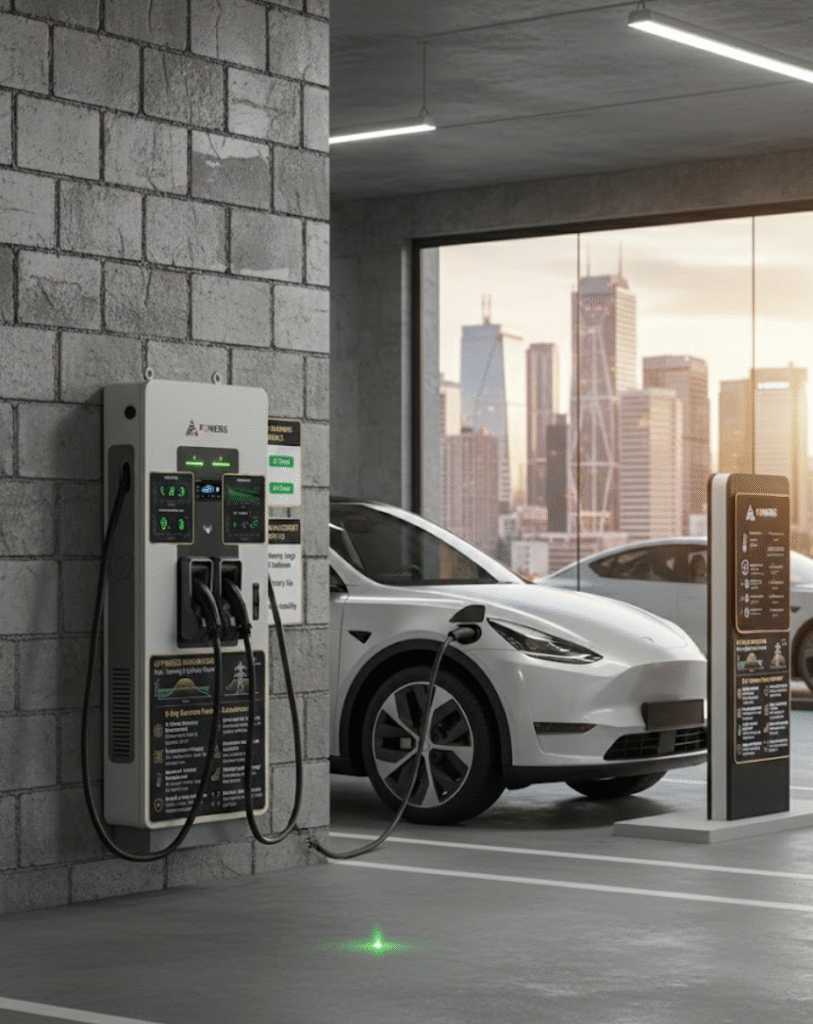
Risk Heatmap – Severity & Frequency (2026 EU Operators)
| Risk Category | Severity (1–10) | Frequency (2026 est.) | Financial Impact (€/site/year) | Primary Trigger |
|---|---|---|---|---|
| Charge-discharge mismatch | 9 | Very High | 8,000–18,000 | Poor BMS–charger communication |
| Accelerated battery degradation | 8.5 | High | 12,000–25,000 | Sub-optimal cycle strategy |
| Thermal runaway / safety event | 10 | Medium | 50,000+ (catastrophic) | Inadequate cooling + high C-rate |
| Compatibility & protocol issues | 7.5 | High | 5,000–12,000 | Voltage/current mismatch |
| Cost overrun during integration | 7 | High | 15,000–35,000 | Delayed commissioning |
| Grid feedback instability | 8 | Medium | 6,000–14,000 | Voltage/frequency fluctuation |
| Regulatory / certification gap | 8 | Medium | 10,000–30,000 (fines) | New EU storage safety directives |
| ROI below expectation | 7.5 | Very High | 20,000–50,000 lost opportunity | All above combined |
- Charge-Discharge Coordination Failure Most common cause of accelerated degradation. Chargers push high C-rate while BMS limits current → heat buildup + cycle stress.
- Voltage / Current Protocol Mismatch DC fast chargers (CCS2) and BESS often use different voltage windows → efficiency drop or shutdown.
- Thermal Runaway During Peak Integration Simultaneous fast charging + discharge → thermal overload if cooling is undersized.
- Safety Interlock & Monitoring Gaps Missing hardware/software interlocks → risk of fire or explosion in high-density sites.
- Cost Overruns from Integration Delays Field testing reveals incompatibility → weeks/months of re-engineering.
- Grid Feedback Instability Bidirectional flow causes voltage/frequency fluctuations → grid operator curtailment.
- Regulatory Compliance Gaps New EU battery passport & storage safety directives not met → project halt or fines.
- ROI Collapse from Degradation Battery SoH drops 20–30% faster than projected → payback period doubles.
2026 Mitigation Priority Matrix
| Priority | Action | Expected Impact (Downtime ↓ / ROI ↑) | Implementation Difficulty | Timeline |
|---|---|---|---|---|
| ★★★★★ | Pre-integration compatibility test | 70–90% risk reduction | Medium | Before procurement |
| ★★★★☆ | AI charge-discharge optimizer | 40–60% degradation slowdown | High | 3–6 months |
| ★★★★☆ | Active liquid cooling upgrade | 60–80% thermal risk elimination | Medium-High | 2–4 months |
| ★★★☆☆ | Real-time SoH & thermal monitoring | Early warning, 30–50% faster reaction | Low-Medium | 1–2 months |
| ★★★☆☆ | Phased pilot rollout | Limits exposure to 10–20% of fleet | Low | Immediate |
Remark:
- In 2026 the smartest EV charger energy storage integration turns peak problems into profitable stability.
- Rushing storage integration isn’t efficiency — it’s accelerated battery replacement.
- 70% of hybrid EV charger underperformance in 2026 stems from integration risks, fixable with testing and AI coordination.
FAQ:
Q: Biggest energy storage integration risk in 2026?
A: Charge-discharge mismatch causing 20–30% faster degradation.
Q: Quickest way to reduce risk? A: Pre-test compatibility + deploy AI optimizer.
Share your storage integration challenge or win for POWERIS to get discussion and advice. immediately.